When paper changes the picture

Published:
25 Aug 2026
How Coloursource™, produced in the UK by James Cropper and globally available through Winter & Company, inspired artist Alex Giles to rethink colour, process and possibility.

For years, Alex Giles chased perfect flatness.

No shine. No brush strokes. No reflection. Just colour, rendered with the laser-sharp precision his geometric paintings demanded.

The problem was paint.

“I used to strive for a totally flat finish,” says the Manchester-based artist. “I wanted it to be laser sharp and without any reflection.”

Eventually, he stopped trying.

Then, almost by accident, he found it in paper.

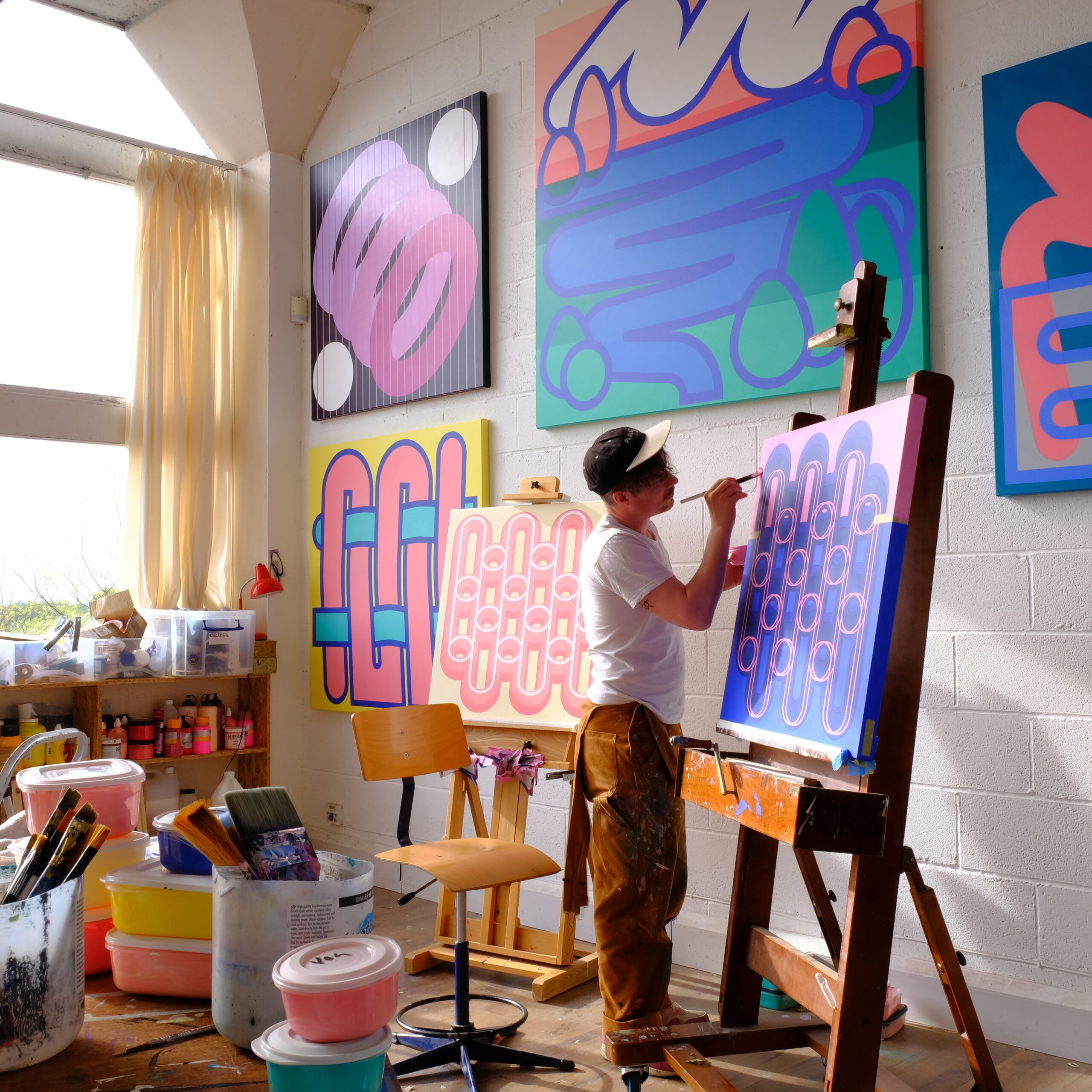
Giles is best known for his large-scale geometric paintings. Bold, vibrant and deliberately disorientating, they invite the eye to wander through repeating lines, shifting colours and optical illusions that reward a second, third and fourth look.

“My job is to make the audience have a good time,” he says. “I like keeping my audience engaged by them thinking, how do I follow that? Where does that go? What links into what?”

Born in Northumberland and now based in Manchester, Giles studied Fine Art before building a career as a production designer in the film industry. In 2020, he committed full-time to painting. His debut solo exhibition, Eye Hurters, was acquired in its entirety by the Deji Museum in Nanjing, with further solo exhibitions quickly following.

Throughout that journey, one thing remained constant.

Canvas.

“Always paint, always canvas,” he says. “It’s reliably good, it’s forgiving and it has a certain texture to it which I enjoy.”

Until one exhibition asked him to leave it behind.

The value of a constraint

When Cross Lane Projects in Kendal invited Giles to contribute to a group exhibition, the brief came with a single condition.

Everything had to be made on paper.

Rather than simply recreating one of his paintings on a different surface, Giles found himself revisiting something much older: the hand-cut greetings cards he used to make for friends.

“Everyone always enjoyed them,” he says. “I started thinking, well, maybe I can scale this up.”

There was an obvious problem.

Paper isn’t canvas.

“You can really put some abuse on canvas and you can still paint on it,” he says. “But with paper, it’s more delicate. If you cut a piece wrong, you’ve got to start again.”

For many artists, that might have been reason enough to simplify the idea.

For Giles, it became the attraction.

“I like constraints,” he says. “I think it pushes you to explore other ideas, new processes.”

Finding the right material eventually led him to James Cropper’s Coloursource™ range.

Proudly produced in the UK by James Cropper and globally available through Winter & Company, Coloursource™ offers 50 colours across three grammages, 135 gsm, 270 gsm and 350 gsm, giving creatives a broad palette of colour, weight and possibility to work with.

“As soon as I’d seen that I could get paper in a large format and in amazing colours, it clicked,” he says. “The colour range that Cropper do is amazing and it’s totally up my street.”

Coloursource™ gave Giles something he hadn’t expected: not simply a material to realise his ideas, but a palette that would begin shaping them.

After producing a small test piece, Giles committed to scaling the idea into a series of layered paper works.

Making something exist

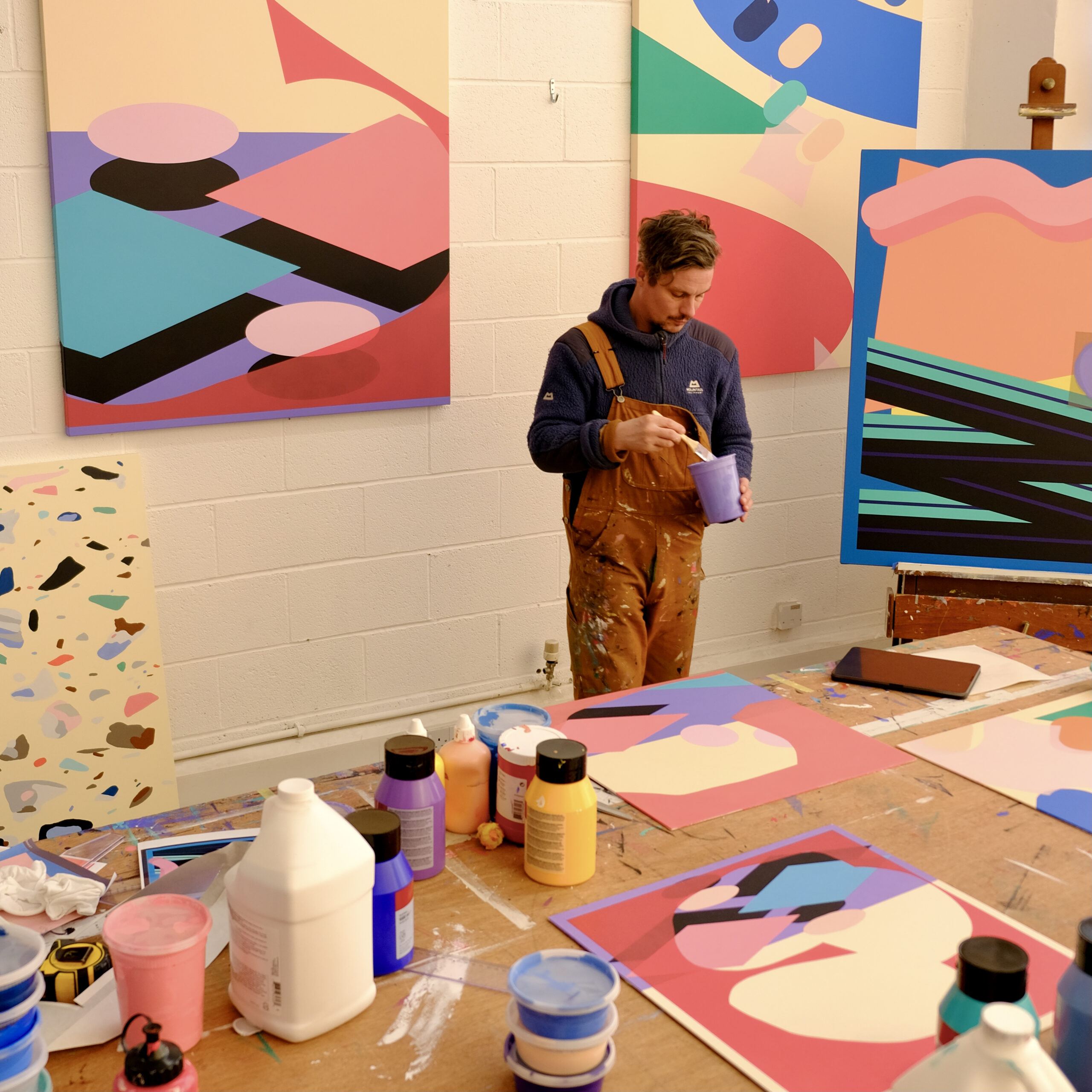
Every Alex Giles artwork begins digitally.

Working in Adobe Illustrator, he designs without worrying about the practicalities of making the work. At that stage, there are no physical limitations.

The challenge comes afterwards.

“There are no limitations when you’re using digital software to create a visual,” he says. “Turning that into a physical item is a different story.”

For Giles, solving that problem is where much of the creativity lies.

“Part of what I see as my creativity is unlocking the puzzle of going: here’s something that I know looks good. Here’s something that speaks to me and my audience on a visual level. How do I make that into something that exists?”

The paper works are built from remarkably simple beginnings.

A single oscillating line is repeated, enlarged and layered until something visually complex begins to emerge.

“It creates, from something very simple, something very visually arresting,” he says. “I’ve always loved optical art.”

Transforming those digital drawings into physical works demanded an entirely new process. Designs had to be adapted for laser cutting, sheets assembled with absolute precision and multiple layers aligned to create subtle depth within an otherwise perfectly graphic image.

“It became quite an intense figuring-out period,” he says. “Very satisfying.”

When the first piece finally came together, the relief was immediate.

“I was so excited because it had worked.”

An unintended collaboration

The material didn’t just shape how the works were made.

It began to influence how they looked.

For one piece, Giles had already designed a colour palette. But when he began laying James Cropper swatches against the artwork, some of his original combinations no longer felt right.

“At first, I felt like I was making compromises when I changed one colour,” he says.

Then something unexpected happened.

“I started to notice that if I took a completely different colour from the palette that I was provided with, then all of a sudden it created something new. A new palette, but one that was actually better than the one I designed.”

Giles describes the experience as an “unintended collaboration”.

At that point, he had never spoken to James Cropper. Yet the Coloursource™ palette had already become part of his creative process.

“I found myself sort of collaborating with what I had on offer,” he says. “I came up with something better than my original idea by following the palette that I had at my disposal.”

Later, when Giles visited James Cropper’s mill, one area immediately resonated.

“Going into the colour lab and seeing how they create bespoke colours for clients with incredibly discerning demands, the accuracy of the reproduction that they can create is amazing,” he says.

“It’s after my own heart.”

As a painter who takes enormous satisfaction from mixing exactly the right colour, Giles recognised the same pursuit of precision in papermaking that he had long pursued in his own studio.

Getting closer

When the finished works went on display, Giles noticed something.

People walked towards them.

From a distance, the pieces appeared almost impossibly flat. Many assumed they were printed.

Then they moved closer.

“People liked getting really close to the work and seeing the layers and seeing that it was paper,” he says. “It was so flat and so precise.”

Only at close range did the engineering reveal itself.

The cut edges became visible. The layers emerged. What looked like a perfectly flat graphic image became a carefully constructed object.

“People like being able to see how something is engineered,” says Giles.

For him, that response was deeply satisfying.

But the biggest surprise belonged to the artist himself.

For years, he had been trying to achieve something in paint that paint simply could not deliver.

Paper could.

“It gives a perfect flat finish, which is almost completely unachievable in paint,” he says.

“After I’d abandoned the idea of ever being able to do that with paint, I was able to achieve it with paper.”

Giles describes the experience as being “reintroduced to paper”.

It is a fitting phrase.

A material he thought he knew had become something entirely different, not simply a replacement for paint but a creative medium capable of changing both his process and his thinking.

Already, he is considering thicker layers, combining paper with paint and exploring new forms of construction.

“The possibilities become kind of endless once you add in lots of different multipliers.”

A brief that began with a restriction led him somewhere entirely unexpected.

Working with Coloursource™, Giles had discovered that paper could offer something paint never could.
Could paper change your picture?

James Cropper is always looking to connect with artists, designers and creators who see new possibilities in paper. If you have an idea, a project or simply a curiosity about where colour and material could take your work, contact the James Cropper team to start a conversation about collaborating.